Book Review//The Worst Hard Time by Timothy Egan
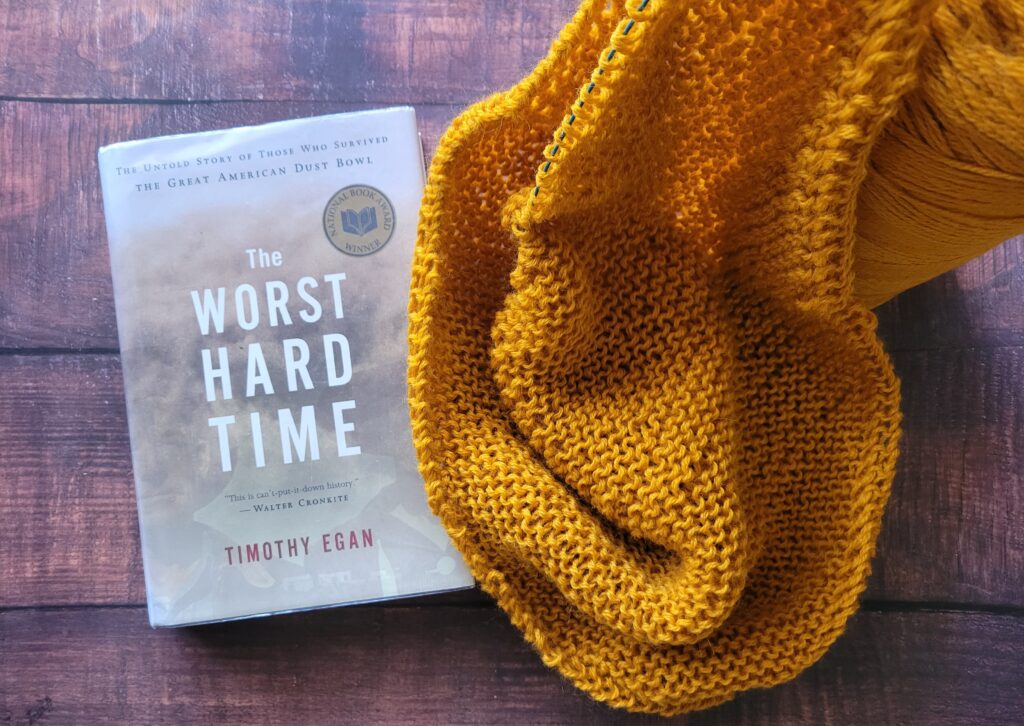
If I mention the American Dust Bowl to you (if you are American) you probably have some basic information that you learned in school. A few photos flash through your mind of families looking poverty-stricken and depressed. You think of dust storms and droughts and bleak landscapes. As with much of history, however, our common knowledge tends to be simply the tip of the iceberg. The Worst Hard Time by Timothy Egan was enlightening, depressing, and absolutely fascinating.
The dust storms that took over the Great Plains in the same years as the Great Depression were unlike anything seen before. People had flooded into the Plains and wheat became a booming crop. Farmers were making their fortune and there seemed no end in sight. Unfortunately, when the farmers disrupted the natural ecosystem everything started to fall apart.
When the native sod of the Great Plains was in place, it did not matter if people looked twice at a piece of ground. Wind blew twenty, thirty, forty miles an hour, as always. Droughts came and went. Prairie fires, many of them started deliberately by Indians or cowboys trying to scare nesters off, took a great gulp of grass in a few days. Hailstorms pounded the land. Blue northers froze it so hard it was like broken glass to walk on. Through all of the seasonal tempests, man was inconsequential. As long as the weave of grass was stitched to the land, the prairie would flourish in dry years and wet. The grass could look brown and dead, but beneath the surface, the roots held the soil in place; it was alive and dormant. The short grass, buffalo, and blue grama, had evolved as the perfect fit for the sandy loam of the arid zone. It could hold moisture a foot or more below ground level even during summer droughts, when hot winds robbed the surface of all water-bearing life. In turn, the grass nurtured pin-tailed grouse, prairie chickens, cranes, jackrabbits, snakes, and other creatures that got their water from foraging on the native turf. Through the driest years, the web of life held.
Then the farmers came and stripped the sod to plant their crops. Acre after acre after acre was put under the plow. “On the Texas Panhandle, two million acres of sod had been turned now—a 300 percent increase over ten years ago. Up in Baca County, two hundred thousand acres. In Cimarron County, Oklahoma, another quarter million acres.” Those figures were for the year 1931. More and more land was plowed and more and more wheat was grown. Eventually, it all started to fall apart; literally and figuratively. The dirt was free to fly.
On May 9, 1934, a flock of whirlwinds started up in the northern prairie, in the Dakotas and eastern Montana, where people had fled the homesteads two decades earlier. The sun at midmorning turned orange and looked swollen. The sky seemed as if it were matted by a window screen. The next day, a mass of dust-filled clouds marched east, picking up strength as they found the jet stream winds, moving toward the population centers. By the time this black front hit Illinois and Ohio, the formations had merged into what looked to pilots like a solid block of airborne dirt. Planes had to fly fifteen thousand feet to get above it, and when they finally topped out at their ceiliing, the pilots described the storm in apocalyptic terms. Carrying three tons of dust for every American alive, the formation moved over the Midwest. It covered Chicago at night, dumping an estimated six thousand tons, the dust slinking down walls as if every home and every office had sprung a leak. By morning, the dust fell like snow over Boston and Scranton, and then New York slipped under partial darkness. Now the storm was measured at 1,800 miles wide, a great rectangle of dust from the Great Plains to the Atlantic, weighing 350 million tons.
The farmers were stuck. The land couldn’t grow anything, their families were starving, their animals were starving, and people were dying from dust pneumonia. There was nowhere to go and no way to stay. There were no provisions for helping the out of work and the poor. You woke up and dug your house out, tried to keep the dust out, ate the tumbleweeds, and did it all again the next day. It was horrifying to read about what people went through.
How to explain a place where black dirt fell from the sky, where children died from playing outdoors, where rabbits were clubbed to death by adrenaline-primed nesters still wearing their Sunday-school clothes, where grasshoppers descended on weakened fields and ate everything but doorknobs? How to explain a place where hollow-bellied horses chewed on fence posts, where static electricity made it painful to shake another man’s hand, where the only thing growing that a human or a cow could eat was an unwelcome foreigner, the Russian thistle? How to explain fifty thousand or more houses abandoned throughout the Great Plains, never to hear a child’s laugh or a woman’s song inside their walls? How to explain nine million acres of farmland without a master? America was passing this land by. Its day was done.
This is the story of destruction and depression, of lives lost and human greed. It is also the story of people doing their best in unbelievably difficult circumstances; of people who wouldn’t give up or who couldn’t give up. It is the story of the destruction of an environment and then its slow rebuilding. It is the story of ignorance and endurance. It is people at their best and worst. It is a fascinating, though not easy to read, book. I highly recommend it.




4 Comments
Joan Kyler
I remember reading this book with horror. The sad thing is that we never seem to learn.
jllee656
That is exactly what I thought.
Michelle Ann
Very inrteresting. Like you, I had heard of the dustbowl, and have read the Little House on the Prairie books, but I had no idea of the scale of devestation.
I saw a documentary on TV recently which warned the prairies are facing another crisis, as they get most of their water from wells which tap deep underground lakes. These are now running dry due to the massive rate of extraction. A worrying concern.
jllee656
It was such an interesting book. But it is so disturbing that there is just one concern after another. The book mentioned those underground lakes.