Book Review//Papyrus: The Invention of Books in the Ancient World by Irene Vallejo
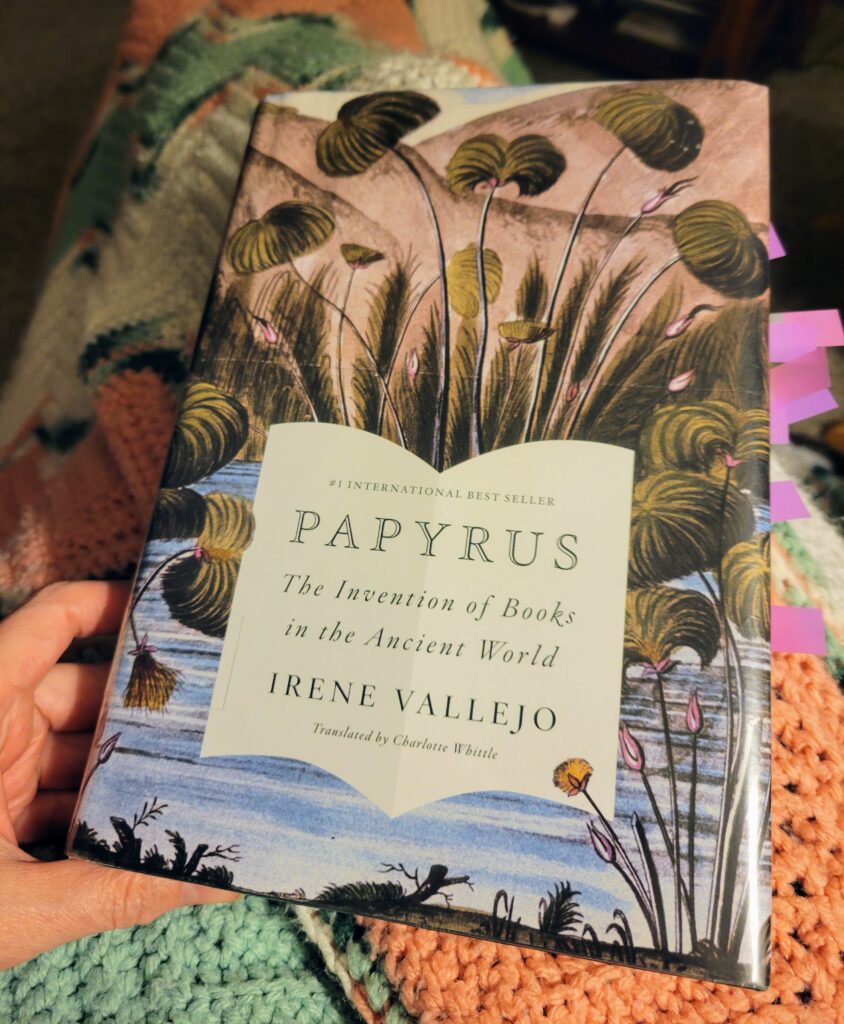
Have you ever taken a walk with a small child? Maybe it was a walk with a particular destination but your child companion does not care how long it takes to get there and is utterly fascinated by every tiny thing along the way. The walk is long, detail-oriented, and utterly fascinating but not quite what you expected. That is how I felt reading Papyrus by Irene Vallejo. I went into it expecting to read about the actual making of books. Instead, I read a book that was part history, part memoir, and wholly about the love of books and reading.
I started this book months ago when I was home recovering from foot surgery. I read about 70 pages and realized that my brain was only capable of reading fluff at the time. This book was something I wanted to fully appreciate, so I set it aside. When I finally picked it up again I read it slowly and marked countless passages. This isn’t going to be a real review. Instead, I am going to insert as many of my favorite quotes as seem reasonable in the hopes of convincing you to read this too. In this first quote, she writes about reading in ancient times.
As we have already seen, reading in ancient times was not the mute activity we practice today. Apart from some striking exceptions, back then people read aloud, even in private. In the eyes of the ancients, the act of sounding out the written letters involved a disturbing kind of bewitchment. The most ancient beliefs taught that a person’s spirit dwelled in their breath. In early funeral inscriptions, the dead begged whoever walked by, “Lend me your voice,” to come back to life and announce who lay in the tomb. The Greeks and Romans believed that any written text must take possession of a living voice to be complete. This is why the reader who scanned the words with their eyes and began to read them underwent a kind of spiritual and vocal possession: their throat was filled with the writer’s breath. The reader’s voice submitted and became one with the written word. The writer, even after his death, used others as a vocal instrument—placing them, in other words, at his service. Being read aloud meant having power over the reader, even across the distances of space and time. That’s why—so the ancients thought—it was appropiate for professional readers and writers to be slaves. Their role was precisely to serve and submit.
Vallejo also wrote this lovely passage about books and friendship.
Books haven’t completely lost that primitive value they had in Rome, the subtle ability to draw a map of fondness and friendship. When we are moved by something we read, the first person we tell is a loved one. When we give a novel or collection of poetry to someone who matters to us, we know their opinion of the text will reflect on us. If a friend or lover places a book in our hands, we seek out their tastes and ideas in the text and feel intrigued, as if the underlined words refer to us; we begin a personal conversation with the written words, becoming more fully open to their mystery. We search the book’s sea of letters for a message in a bottle just for us.
I particularly liked a section about the sanitizing of classic literature since this is a subject on which I have very strong opinions.
But today, the matter remains an open question, as the Louisville professors who erased the insult “nigger” from Twain’s work well know. Are books for children and young adults complex works of literature or codes of conduct? A sanitized Huck Finn can teach young readers a lot, but it robs them of an essential lesson: that there was a time when almost everyone called their slaves “niggers,” and that, due to this history of oppression, the word has become taboo. We won’t save the young from harmful ideas by excising everything we find offensive from books. On the contrary, we’ll make young people less able to spot them. Unlike what Plato says, evil characters are an essential ingredient of traditional tales: they are there for children to learn that evil exists. Sooner or later, they’ll find out about it, whether from bullies stalking them in the schoolyard or from genocidal tyrants.
We will end with one of my favorite quotes from the book. The writing is so beautiful and I have deep admiration for Vallejo and also for her translator, Charlotte Whittle. What a job it must be to be a translator and to preserve not only the words but the spirit of a book.
And yet, since time immemorial, women have told stories, sung songs, and threaded together lines of verse in the glow of the fireside. When I was a little girl, my mother unfurled before me a world of whispered stories. This was no coincidence. Throughout the ages, women have held the role of unraveling stories by night. Women have been the weavers of tales and tapestries. For centuries, they have unspooled their stories as they spun or threw the shuttle on their loom. They were the first to capture the universe as warp and weft. They knotted together their joys, hopes, sorrows, fears, and most private beliefs. They dyed drudgery, giving it color. They interlaced verbs, yarn, adjectives, and silk. This is why text and textiles share so many words: the thread of the story, the dénouement of the narrative, the fabric of the argument; weave a plot, embroider a tale, spin a yarn. This is why the old myths speak to us of Penelope’s shroud, Nausicaa’s tunics, Arachne’s embroidery, Ariadne’s thread, the thread of fate spun by the Moirai, the canvas of human fate sewn by the Norns, the magical tapestry of Scheherazade.
Now my mother and I whisper those nighttime stories in my son’s ears. Though I am no longer that little girl, I write so the stories won’t come to an end. I write because I don’t know how to sew or knit; I never learned to embroider, but I am fascinated by the delicate warp and weft of words. I tell my fantasies wound in a skein of dreams and memories. I feel like an heir to those women who have always woven and unwoven stories. I write so the old thread of voices will not be frayed.
There are so many other wonderful quotes and fascinating facts. I hope by giving you a taste of this book you will want to go out and read it yourself. It is a lovely paean to the development of books and the love of reading.


5 Comments
Marilyn Chappell
I am entranced.
Katrina
It sounds fascinating, I’ve put it on my list. Thank you.
jllee656
I think you will like it.
Juxtabook
How lovely, especially the final passage. A book to add to my ‘to buy’ list. Thnak you.
jllee656
I hope you enjoy it.