Book Review//The Rush: America’s Fevered Quest for Fortune 1848-1853 by Edward Dolnick
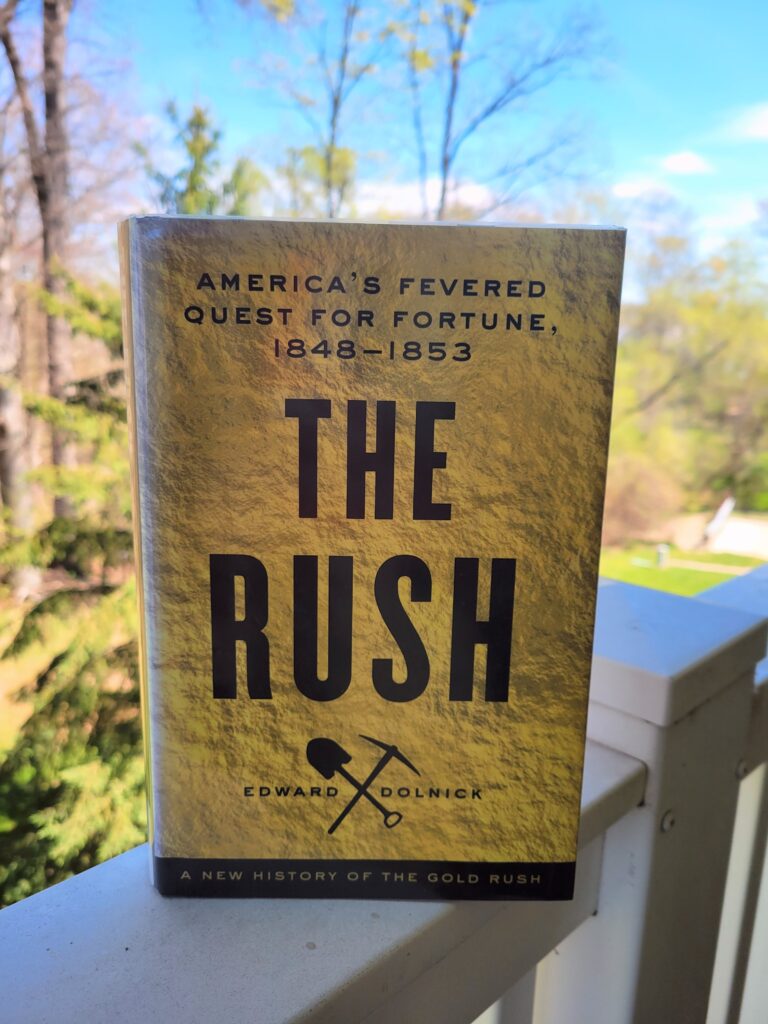
When I was a kid I was fascinated by the gold rush. I think this fascination might have been sparked by a book I read (of course) called The Golden Venture by Jane Flory. It is the story of a young girl who stows away in her father’s wagon when he heads off for the California gold fields. I don’t remember the book too clearly anymore but I know she had lots of adventures and, at one point she made her home on an abandoned ship. I have requested a copy of the book from the library. It is always a risk rereading books you loved as a child but I’ll take that risk.
This post, as you may have noticed from the title, is not about The Golden Venture but it is about another book about the gold rush. The Rush was recommended by a co-worker and she was right; I thoroughly enjoyed it. I learned all kinds of facts about the time; all of it fascinating and much of it horrifying.
I knew many of the basic premises of the gold rush. Gold was found at Sutter’s mill. People flocked there and panned for it. Fortunes were found and lost. But, as with any period of history, there is so much more to the story. Dolnick writes just the kind of account I enjoy. It is full of details, personal accounts, and background information that make history come alive.
Did you know that nine days after gold was found at Sutter’s mill and before the news spread Mexico gave California to the U.S. as part of the settlement of the Mexican-American War? Did you also know that the band of gold-rich quartz in the Sierra foothills was over 120 miles long? And the journey to get to California was, quite frankly, unbelievable.
For many of the gold-seekers, that step back into an earlier age would prove a shock. They had studied their guidebooks, but they had not truly grasped what they had read. They had no idea what it would mean to travel thousands of miles with scarcely any sources of food beyond what you could carry or shoot, no access to water if the river you were following dried up, no recourse if your oxen sickened or your mules died. No idea, above all, what it would mean to cross a vast continent on foot. For no matter its name, the rush was a race run at a crawl. Two miles an hour was a standard pace, fifteen miles a day good progress.
Most people started out with boundless enthusiasm and too many possessions. Both those things were whittled down by the trail ahead of them. It wasn’t too bad at first but after four months of walking they reached the deserts of Nevada. The water was foul and not easily found and the heat was relentless.
Sunrise the next day opened a curtain on a nightmare, unveiling “a scene more horrid than the rout of a defeated army,” in the words of the Illinois lawyer Eleazer Ingalls. “Dead stock line the roads, wagons, rifles, tents, clothes, everything but food may be found scattered along the road; here an ox, who standing famished against a wagon bed until nature could do no more, settles back into it and dies; and there a horse kicking out his last gasp in the burning sand, men scattered along the plain and stretched out among the dead stock like corpses, fill out the picture.”
Ingalls concluded with a heartfelt prayer. “The desert! You must see it and feel it in an August day, when legions have crossed it before you, to realize it in all its horrors. But heaven save you from the experience.”
Once they arrived in California their trials were not over. It was a rough, difficult life ahead of them.
In truth, a miner could count on nothing except that he would work not at half his capacity but to the extreme limit of his strength and stamina. The diggings were aptly named. “The labor of gold-digging is unequalled by any other in the world in severity,” wrote one dismayed soldier-turned-miner. “It combines, within itself, the various arts of canal-digging, ditching, laying stone-walls, ploughing, and hoeing potatoes.”
The miners themselves were not the only ones making money. There are accounts of barbers collecting the gold dust from the hair their clients left behind. The miners were profligate with the gold they found and happily spent it as soon as they found it. California also needed many supplies and services and charges for these were high.
California needed everything and had nothing—no picks or shovels or beds or blankets or nails or bricks, and few men willing to do any labor except dig for gold. (In 1850 there were 624 miners for every 1,000 people in California.) With nearly everyone off to the mines, wages for carpenters, blacksmiths, and masons tripled and quadrupled, sometimes reaching $15 or $20 a day. Anyone who could drive a nail, stitch a boot, plow a field, bake a pie could take in money. Deliverymen could earn $6,000 a year ($120,000 in today’s money).
The gold rush was a time of adventure, treasure, and amazing stories but it was also a time of death, disease, and failure. One of the true tragedies of the time was how the Native Americans were treated once the white miners started to arrive.
No group suffered as much in the gold rush years as Native Americans. For California’s Indians, the rush was a calamity. Before gold was discovered, Indians had outnumbered whites nearly ten to one. By the early 1850s, they were strangers in their own land, outnumbered two to one. Worse still, California’s Indians happened to live in the greatest numbers in the very regions where gold was found. The white invasion came straight to those traditional enclaves, like a knife to the heart. These new enemies, moreover, represented a new threat rather than a familiar danger magnified. The Spanish-speaking ranchers who dominated California in pre-gold rush days had exploited the Indians, but they needed their labor. The newly arrived whites had no brakes on their mistreatment. They simply wanted the Indians gone. Soon they were.
It is fun to read the novels set during the gold rush; the adventures, the gutsy heroine, the nuggets lying around. But, as with any time in history, the truth is so much more. It is still full of adventure and people doing seemingly impossible things but the nuances add to the story. Edward Dolnick’s book fleshed out the history in a fascinating, readable way.




2 Comments
Lucinda
After the American gold rush, came the Australian one in the 1850s, with many from California making their way to the colonies in Australia (which didn’t exist as a country then) for the next gold rush. Ideas travelled with the men which led to a political insurrection, the Eureka Stockade. One who came over was one of my husband’s ancestors.
As you can see, I too am interested in the gold rush. I visited Suttors Fort in Sacramento and was disappointed to find out it is a reconstruction. When we visited the State Capitol, the guide responded to a question on who was here first, with, “There was no one before the Mexicans,” effectively wiping out the indigenous American peoples. I could see the fellow tourist who asked was shocked. In the state parliament building to deny there were people here! (Though they were painted on a mural in the building looking very pleased to see people coming onto their lands.)
jllee656
I don’t know much about the Australian gold rush. I’ll have to find a book on that.
What a horrifying thing for that guide to say.