Book Review//Shakespeare: The World as Stage by Bill Bryson
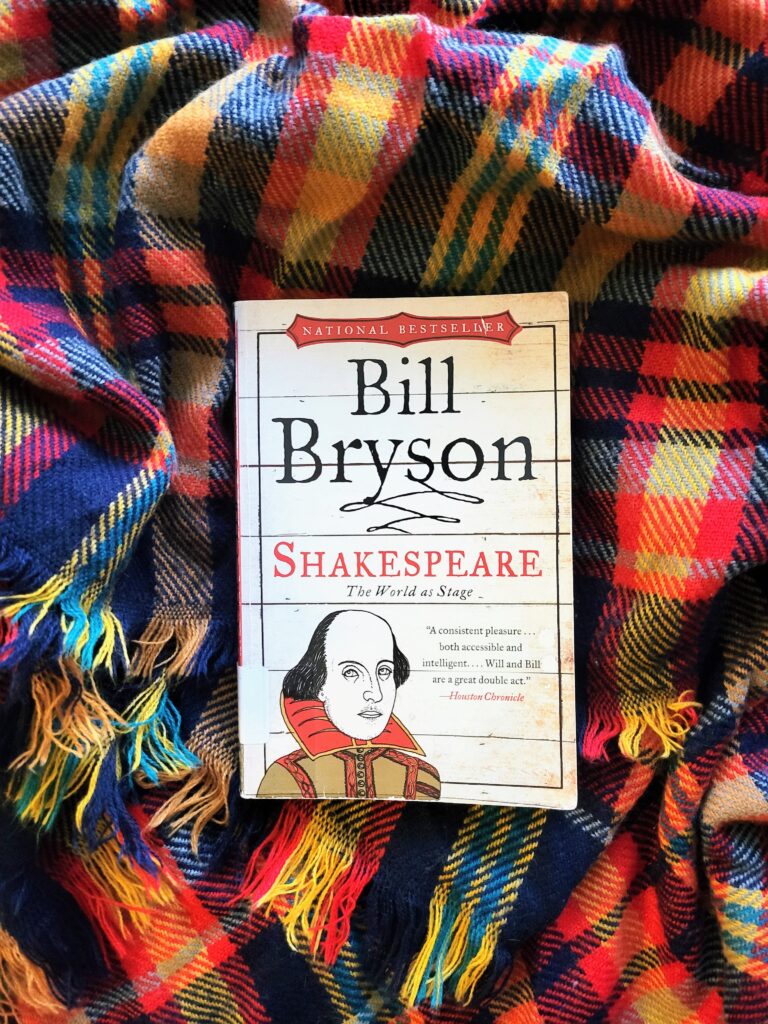
We all know Shakespeare, don’t we? A playwright, lived in Stratford-Upon-Avon, left his wife his second-best bed, “to be or not to be” and all that. But who really was Shakespeare and what do we actually know about him? How do we separate the man and the myth? Bill Bryson addresses these questions in a very engaging and well-written book. He starts by addressing how little we actually know.
Although he left nearly a million words of text, we have just fourteen words in his own hand–his name signed six times and the words “by me” on his will. Not a single note or letter or page of manuscript survives. (Some authorities believe that a section of the play Sir Thomas More, which was never performed, is in Shakespeare’s hand, but that is far from certain.) We have no written description of him penned in his own lifetime. The first textual portrait–“he was a handsome, well-shap’t man: very good company, and of a very readie and pleasant smooth witt”–was written sixty-four years after his death by a man, John Aubrey, who was born ten years after that death. . . . We don’t know if he ever left England. We don’t know who his principal companions were or how he amused himself. His sexuality is an irreconcilable mystery. On only a handful of days in his life can we say with absolute certainty where he was. We have no record at all of his whereabouts for the eight critical years when he left his wife and three young children in Stratford and became, with almost impossible swiftness, a successful playwright in London. By the time he is first mentioned in print as a playwright, in 1592, his life was already more than half over.
We know so little about Shakespeare but he has left us so much that has continued to enthrall readers and playgoers for generations. His mark is upon the language we speak and the idioms we use. English would not be what it is if we did not have Shakespeare.
His real gift was as a phrasemaker. “Shakespeare’s language” says Stanley Wells, “has a quality, difficult to define, of memorability that has caused many phrases to enter the common language.” Among them: one fell swoop, vanish into thin air, bag and baggage, play fast and loose, go down the primrose path, be in a pickle, budge an inch, the milk of human kindness, more sinned against than sinning, remembrance of things past, beggar all description, cold comfort, to thine own self be true, more in sorrow than in anger, the wish is father to the thought, salad days, flesh and blood, foul play, tower of strength, be cruel to be kind, blinking idiot, with bated breath. . . pomp and circumstance, foregone conclusion–and many others so repetitiously irresistable that we have debased them into clichés. He was so prolific that he could (in Hamlet) put two in a single sentence: “Though I am native here and to the manner born, it is a custom more honoured in the breach than the observance.”
If we take the Oxford Dictionary of Quotations as our guide, than Shakespeare produced roughly one-tenth of all the most quotable utterances written or spoken in English since its inception–a clearly remarkable proportion.
Because so little is known about Shakespeare there is theory after theory that has sprung up around him and his plays. Many of those theories revolve around the actual authorship of the plays. Could Shakespeare have written them? Did he have the necessary education and background? Many others have been put forward as possible authors, but Bryson debunks them all.
So it needs to be said that nearly all of the anti-Shakespeare sentiment–actually all of it, every bit–involves manipulative scholarship or sweeping misstatements of fact. Shakespeare “never owned a book,” a writer for the New York Times gravely informed readers in one doubting article in 2002. The statement cannot actually be refuted, for we know nothing about his incidental possessions. But the writer might just as well have suggested that Shakespeare never owned a pair of shoes or pants. For all the evidence tells us, he spent his life naked from the waist down, as well as bookless, but it probable that what is lacking is the evidence, not the apparel or the books.
I could go on and on spouting quotes from the book and bits of information I gleaned but I won’t because you need to go read this. It was interesting, entertaining, and informative. Bill Bryson has a unique ability to take a topic and make it accessible and fun to learn about. In the case of Shakespeare, he took a topic, continually told the reader there wasn’t any concrete information on the subject, and yet, continued to keep the reader completely engaged. We don’t know a lot about Shakespeare but, thanks to Bryson, I know quite a bit more than I used to.


4 Comments
Katrina
What a great post, I’ll definitely seek this book out. Have you been to Stratford?
jllee656
We did go to Stratford but we didn’t tour the Shakespeare houses or anything. We just did a lot of wandering around. I would like to go back.
Lucia T Schneck
I always come to such things too late. Always a Shakespeare fan as well as a Bryson fan, nevertheless I did not know that the latter had written about the former. I only stumbled on this factoid, because currently I am reading Maggie O’Farrell’s book, Hamnet (upon which the movie is based).. To my amazement, she credits Bryson’s book in her acknowledgements.
Just a sidenote. I did go to Stratford many many moons ago, and I did visit Shakespeare’s birthplace on Henly St. and It was pretty “great,” though of course crowded; but that too could have been worse. Yes you should go back and get it all, including Anne Hathaway’s house, the church where he is buried, etc. etc. Drop off some money at the wonderful nearby inns and celebretory falderah…..It will be well worth it.
jllee656
I have heard a lot about Hamnet but haven’t read it yet. Are you enjoying it?
One day I shall make it back to England and do all the Shakespeare things. Something to dream about.